
Buying a new home in North Texas starts with a different document than buying resale: the builder's own purchase contract. Most builders selling their own homes use their own contract rather than a Texas Real Estate Commission form, and that contract, not a standard form, sets your earnest money terms, deposits, cancellation rights, completion date, and warranty. I am Theresa De La Rosa, Broker of Covenant Heritage Realty, LLC, and for more than 18 years I have helped relocating buyers and move-up families review new-construction contracts across Northlake, Argyle, Flower Mound, and Justin. This guide explains what a new-construction contract typically contains, where it differs from a TREC resale contract, and what to verify before you sign.
Quick Answers
These are the short answers; the sections below show the sources and the verification steps.
- Do I sign a TREC form when buying new construction? Not necessarily. TREC publishes two new-home forms, the New Home Contract (Incomplete Construction) and the New Home Contract (Completed Construction), and some builders use them, but a builder selling its own homes typically uses its own contract. TREC's rule requiring license holders to use promulgated forms does not reach a contract prepared by the property owner.
- Is earnest money required by Texas law? No. Earnest money is a negotiated deposit, not a legal requirement. Under TREC contracts it is delivered to the escrow agent within 3 days of the effective date; under a builder's own contract, the builder's terms govern.
- Do new-construction contracts include an option period? Not always. TREC contracts give the buyer a negotiated option period with a separate option fee, commonly 7 to 10 days. Many builder contracts omit the TREC-style option period or allow only a short window, so ask in writing what cancellation rights you actually have.
- What warranty comes with a new home? Express warranties are stated in the builder's contract, and Texas courts recognize implied warranties of good workmanship and habitability in the sale of a new home. Construction-defect claims are governed by the Texas Residential Construction Liability Act, which requires written notice before suit and gives the builder a right to inspect and offer to cure.
- Can I sign a new-construction contract from out of state? Yes. Texas does not require you to be present to sign, and builders routinely work with out-of-state buyers through electronic signatures and remote closings. Have the contract and specifications reviewed by someone local, and visit at framing or before closing if you can.
Table of Contents
- Which Contract Do You Sign? Builder Contract vs TREC Form
- Earnest Money and Deposits
- The Option Period
- What the Builder's Contract Should Spell Out
- The Builder Warranty and Texas Construction-Defect Law
- What to Verify Before You Sign
- New Construction Contracts for Out-of-State Buyers
- Frequently Asked Questions
- Conclusion
- How I Can Help
- Primary Sources
Which Contract Do You Sign? Builder Contract vs TREC Form
The Texas Real Estate Commission promulgates standard contract forms that its license holders are generally required to use for the transactions they handle. For new homes, TREC publishes two: the New Home Contract (Incomplete Construction), used when the home is not yet complete at signing, and the New Home Contract (Completed Construction), used when it is. Some builders use these forms, and some use forms modeled on them.
But a builder selling its own homes is not a third party to the transaction in the same way a listing agent is. TREC's rule requiring license holders to use promulgated forms, found in 22 Texas Administrative Code Section 537.11, does not reach a contract prepared by the property owner, so the builder is not required to use a TREC form. In practice, many builders in Northlake, Argyle, Flower Mound, and Justin present their own purchase agreement, often several pages longer than a resale contract, with their own financing, deposit, completion, and warranty provisions.
The practical consequence for a relocating buyer: read the builder's contract as the actual terms of your purchase, not as a version of the TREC resale form you may have seen. The guide to understanding new-construction phases explains the phase, lot, and pricing vocabulary that appears in these contracts, and the true cost of new construction guide shows how the contract price becomes the total you actually pay.
Earnest Money and Deposits
Texas law does not require earnest money. It is a negotiated deposit that shows the seller you are serious, and it is typically held in escrow by a title company. Under TREC's new-home and resale contracts, the buyer must deliver earnest money to the escrow agent within 3 days after the effective date, and the option fee must also be delivered within 3 days. TREC's guidance on earnest money delivery and option fee delivery is linked in the Primary Sources below.
In a builder's own contract, the builder's terms govern instead. Two differences matter most for relocating buyers. First, deadlines can differ from the TREC 3-day standard, so confirm the exact date by which earnest money must be delivered. Second, deposits in new construction are not always refundable: earnest money, lot deposits, and design-center or upgrade deposits may become non-refundable at different points, sometimes before you have financing approved or before construction starts.
Ask the builder, in writing, three questions about every deposit: how much, when it is due, and when it becomes non-refundable. Also ask what happens if your financing falls through, if the appraisal comes in low, or if the completion date slips. For VA buyers, the VA new-construction guide covers the VA escape clause and the important point that VA says builder upgrade deposits are not earnest money and are not covered by the escape clause.
The Option Period
In a Texas resale transaction, the buyer commonly pays a separate, negotiated option fee to buy an unrestricted right to terminate the contract for any reason during the option period, typically 7 to 10 days. If the buyer terminates within that window, the earnest money is refunded and the option fee is credited toward the price at closing. That structure exists because the TREC contract provides for it.
Builder contracts frequently omit the TREC-style option period entirely, or allow only a very short one. That means you may have little or no unilateral right to walk away once you sign, apart from whatever contingencies the contract contains. Before you sign, ask the builder directly: is there an option period, and if so, what is the fee, how long does it last, and what happens to the earnest money if I terminate?
If the builder offers no option period, protect yourself with the contract's other terms instead: a financing contingency, an appraisal contingency if you can negotiate one, an inspection or walkthrough right, and a clear completion date with consequences for delay. The upgrades guide covers the design-center side of the contract, where change orders and selection deadlines can quietly extend your timeline and your price.
What the Builder's Contract Should Spell Out
A complete new-construction contract should put the following in writing. If any of these is missing, ask for it in an addendum before you sign:
- The homesite: the legal description, lot number, section, and phase, so there is no ambiguity about which property you are buying.
- Plans and specifications: which version of the floor plan, elevations, and specifications governs, and how the builder may substitute materials of equal or better quality.
- Price in writing: base price, lot premium, included features, design-center allowance, and how change orders are priced and approved.
- Completion and closing: the estimated completion date, the closing date and location, how delays are handled, and what happens if the home is not ready on time.
- Financing: the financing contingency, the deadline to obtain a loan commitment, and what happens if you cannot obtain financing.
- Walkthrough and inspection: your right to a pre-closing walkthrough, any builder inspection limits, and the punch-list process after closing.
- Warranty and dispute resolution: the express warranty terms, how claims are submitted, any arbitration clause, and how the Residential Construction Liability Act applies.
If you are comparing builders, bring the same questions to each contract and compare the answers side by side. The community comparison guide shows how to weigh the non-contract factors, schools, taxes, HOA, and commute, that sit behind the signature.
The Builder Warranty and Texas Construction-Defect Law
A new home in Texas comes with two layers of warranty. First, the express warranties stated in the builder's contract, which can include a limited warranty covering specific systems and time periods, often with a separate warranty document delivered at closing. Second, Texas courts have long recognized implied warranties of good workmanship and habitability that run with the sale of a new home, in addition to whatever the contract states. The Texas State Law Library's construction-defects guide, linked below, is a reliable overview of both.
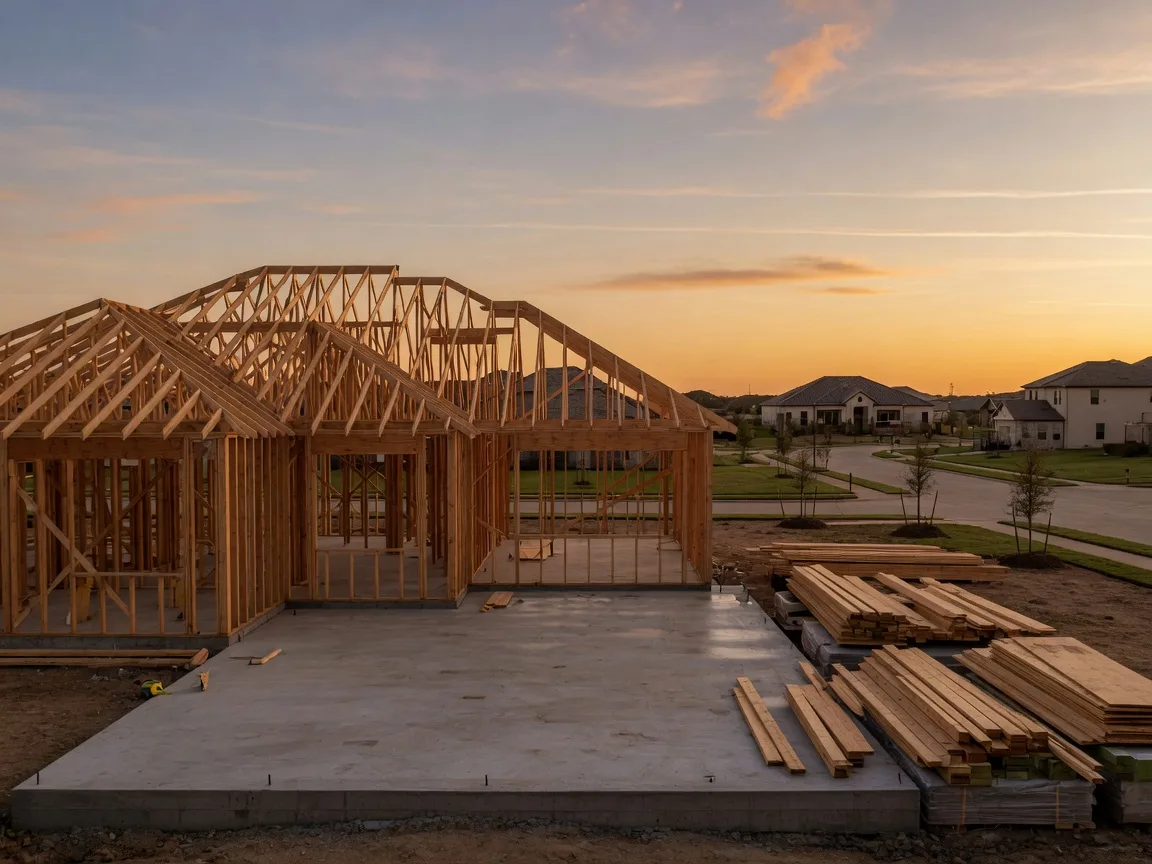
The framing stage is the best time for an independent inspection, before the walls close and the warranty clock starts.
Construction-defect claims against a home builder are governed by the Texas Residential Construction Liability Act, Texas Property Code Chapter 27. The Act sets a specific process before you can sue or arbitrate. At least 60 days before filing suit, the homeowner must send the builder written notice by certified mail, return receipt requested, describing each construction defect in reasonable detail and providing evidence of its nature, cause, and needed repairs if the builder requests it. A suit filed without proper notice can be abated, meaning the court pauses it until the notice requirement is satisfied.
The Act also gives the builder a right to respond. Within 35 days of receiving notice, the builder may inspect the property, up to three times, to evaluate the defect. Within 45 days of receiving notice, the builder must make a written offer of settlement, either to repair the defect or to pay monetary damages. If the homeowner accepts a repair offer, the builder generally must complete the repair within 30 days of acceptance. If the builder makes a reasonable offer and the homeowner rejects it, the damages the homeowner can recover may be capped; if the builder makes no reasonable offer, those caps do not apply.
Deadlines matter. Texas applies statutes of limitations and a statute of repose to construction-defect claims. Claims against those who construct or repair improvements generally must be filed within 10 years of substantial completion, and 2023 legislation shortened some residential construction periods, including for major structural components. General limitations periods also apply by cause of action, commonly 2 years for negligence and most DTPA claims and 4 years for breach of a written contract or warranty. Because these windows vary by claim type, get legal advice early if you believe you have a defect issue, and keep your contract, specifications, change orders, photos, and correspondence from the day you sign.
What to Verify Before You Sign
Use this checklist for every new-construction contract you are seriously considering, and get every answer in writing from the builder.
- Contract form: confirm whether you are signing the builder's own contract or a TREC new-home form, and have the actual document reviewed before you sign.
- Earnest money: amount, due date, who holds it, and every condition under which it is refunded or forfeited.
- Deposits: lot, design-center, and upgrade deposits, when each becomes non-refundable, and what happens if financing or construction timing changes.
- Cancellation rights: any option period or other right to terminate, in writing, including what you recover if you do.
- Price and inclusions: base price, lot premium, included features, design-center allowance, and how change orders are priced.
- Completion and delay: estimated completion date, closing date, and what the builder owes you, if anything, if the home is late.
- Warranty terms: what is covered, for how long, how to file a claim, and any arbitration clause.
- Inspections: your right to an independent inspection at framing and before closing, and any builder limits on third-party inspectors.
- Builder track record: how many homes the builder has delivered in that community and how it handles punch lists and post-closing service.
- By-address facts: school assignment, municipality or ETJ, taxing entities including any MUD, PID, or WCID, and HOA dues for the exact homesite, not the community brochure.
The school districts guide explains how to confirm an assignment by address, and the property taxes and ownership costs guide shows how to read the tax bill, including special-district assessments, for the exact property.
New Construction Contracts for Out-of-State Buyers
Texas does not require you to be present to buy a home, and builders routinely work with relocating households who sign purchase agreements from out of state. Electronic signatures are standard, and closings can be conducted remotely with a notary, including remote online notarization. What you cannot do from a distance is inspect the home yourself, so the contract's inspection rights matter even more: schedule an independent inspector at framing and again before closing, and visit the site at framing or before closing if you can.
The remote home buying guide walks through the full out-of-state process, and the relocation guides for Argyle, Northlake, Flower Mound, and Justin cover the community-level facts to verify alongside the contract.
Frequently Asked Questions
Do I sign a TREC form when I buy new construction?
Not necessarily. TREC publishes two new-home forms, the New Home Contract (Incomplete Construction) and the New Home Contract (Completed Construction), and some builders use them. But a builder selling its own homes typically uses its own contract, and TREC's rule requiring license holders to use promulgated forms does not reach a contract prepared by the property owner. Confirm which document you are signing and have it reviewed.
Is earnest money refundable in new construction?
It depends on the contract. Under TREC contracts, earnest money is refunded if the buyer terminates during the option period. In a builder's own contract, the builder's terms govern, and earnest money, lot deposits, and design-center deposits may become non-refundable at different points. Ask, in writing, when each deposit becomes non-refundable and what happens if financing or the completion date changes.
Do new-construction contracts have an option period?
Not always. TREC contracts provide a negotiated option period with a separate option fee, commonly 7 to 10 days, during which the buyer can terminate for any reason. Many builder contracts omit the TREC-style option period or allow only a short window. Ask the builder in writing what cancellation rights you have and what you recover if you exercise them.
What warranty do I get with a new home in Texas?
Express warranties are stated in the builder's contract, often in a separate limited warranty document delivered at closing. Texas courts also recognize implied warranties of good workmanship and habitability in the sale of a new home. Construction-defect claims are governed by the Texas Residential Construction Liability Act, which requires written notice before suit and gives the builder a right to inspect and offer to cure.
What happens if the builder is late completing the home?
It depends on the contract's delay provisions. Some contracts give the builder an automatic extension for weather, permits, and other listed causes, and some include a per-day credit to the buyer if the builder misses the completion date without a permitted cause. Ask for the delay clause in writing and understand what happens to your rate lock and your temporary housing if closing slips.
Should I have a lawyer review a builder's contract?
It is a reasonable step for any new-construction purchase, and especially for relocating buyers who cannot easily revisit the builder's office. A Texas real estate attorney can flag non-refundable deposits, one-sided delay or substitution clauses, warranty limits, and arbitration provisions before you sign. This article is general information, not legal advice, and is not a substitute for your own attorney's review.
Can I buy new construction from out of state?
Yes. Texas does not require you to be present to sign, and builders work with out-of-state buyers through electronic signatures and remote closings. Plan for an independent inspection at framing and before closing, and visit the site if you can. The remote home buying guide covers the process in detail.
Conclusion
The most important thing to understand about a new-construction purchase in Texas is that the builder's contract is the deal. It decides how your earnest money and deposits are treated, whether you have an option period, when the home will be finished, what the warranty covers, and how a dispute would be handled. TREC's new-home forms exist and some builders use them, but many do not, so the document in front of you is the one that counts.
For relocating buyers, the same discipline applies as everywhere else on this site: verify by address and verify in writing. Confirm the homesite, the plans, the price, the deposits, the completion date, the warranty, the school assignment, the taxing entities, and the HOA for the exact property, and have the contract reviewed before you sign. The new construction hub and the community guides index are good places to start, and I am glad to walk through the verification with you.
How I Can Help
As the Broker of Covenant Heritage Realty, LLC, I help relocating households and move-up buyers compare new-construction contracts and communities across Northlake, Argyle, Flower Mound, and Justin. That means reviewing the contract terms that matter, verifying the by-address facts behind the signature, and making sure you know what you are committing to before you sign. Clients tell me the value of that approach is feeling informed and supported instead of pressured, and you can read about those experiences in the client success stories.
Builder contracts, deposits, option periods, warranties, completion dates, pricing, HOA dues, tax rates, and school boundaries all change and must be verified directly with the applicable sources as of the date you buy. I help clients verify those details for the exact homesite before they commit, and I would be glad to do the same for you.
Primary Sources
- Texas Real Estate Commission, New Home Contract (Incomplete Construction)
- Texas Real Estate Commission, Contracts (including New Home Contract Completed Construction 24-20)
- Texas Real Estate Commission, How long does an agent have to deposit earnest money
- Texas Real Estate Commission, Changes to Delivery of Option Fee
- Texas Property Code, Section 27.004, Notice and Offer of Settlement (Residential Construction Liability Act)
- Texas Civil Practice and Remedies Code, Section 16.009, Persons Furnishing Construction or Repair of Improvements
- Texas State Law Library, Construction Defects consumer protection guide
Texas Administrative Code, 22 TAC Section 537.11 (Standard Contract Forms) is referenced in the discussion of promulgated forms. Information reviewed October 12, 2026. Contract terms, deposits, option periods, warranties, completion dates, pricing, HOA dues, tax rates, special-district assessments, and school boundaries change and must be verified directly with the applicable sources as of the date you buy.
Disclosure
Contract forms, deposit terms, option periods, warranties, completion dates, municipality boundaries, school districts, attendance zones, tax rates, special-district assessments, HOA dues, builder participation, available homes, prices, and road-project schedules can change. Information was reviewed on October 12, 2026. Buyers should verify current information with builders, developers, HOAs, municipalities, school districts, taxing authorities, lenders, title companies, inspectors, attorneys, and appropriate professional advisers. Theresa De La Rosa is a Texas Real Estate Broker at Covenant Heritage Realty, LLC, Licensed in Texas (Broker, License #807294). This article is for general informational purposes and is not legal, tax, lending, construction, or investment advice. Equal Housing Opportunity.
Last Reviewed: October 22, 2026.
About to sign a new-construction contract? Get guidance before you commit.
I grew up around my family's home-building business, worked in builder marketing and new-home sales, and studied real estate during my MBA. Today, I help North Texas buyers compare homes, builder offers, community costs and construction timelines.
Plan My New-Construction Purchase Theresa De La Rosa
Broker, REALTOR®
Covenant Heritage Realty, LLC | In DFW Living Group