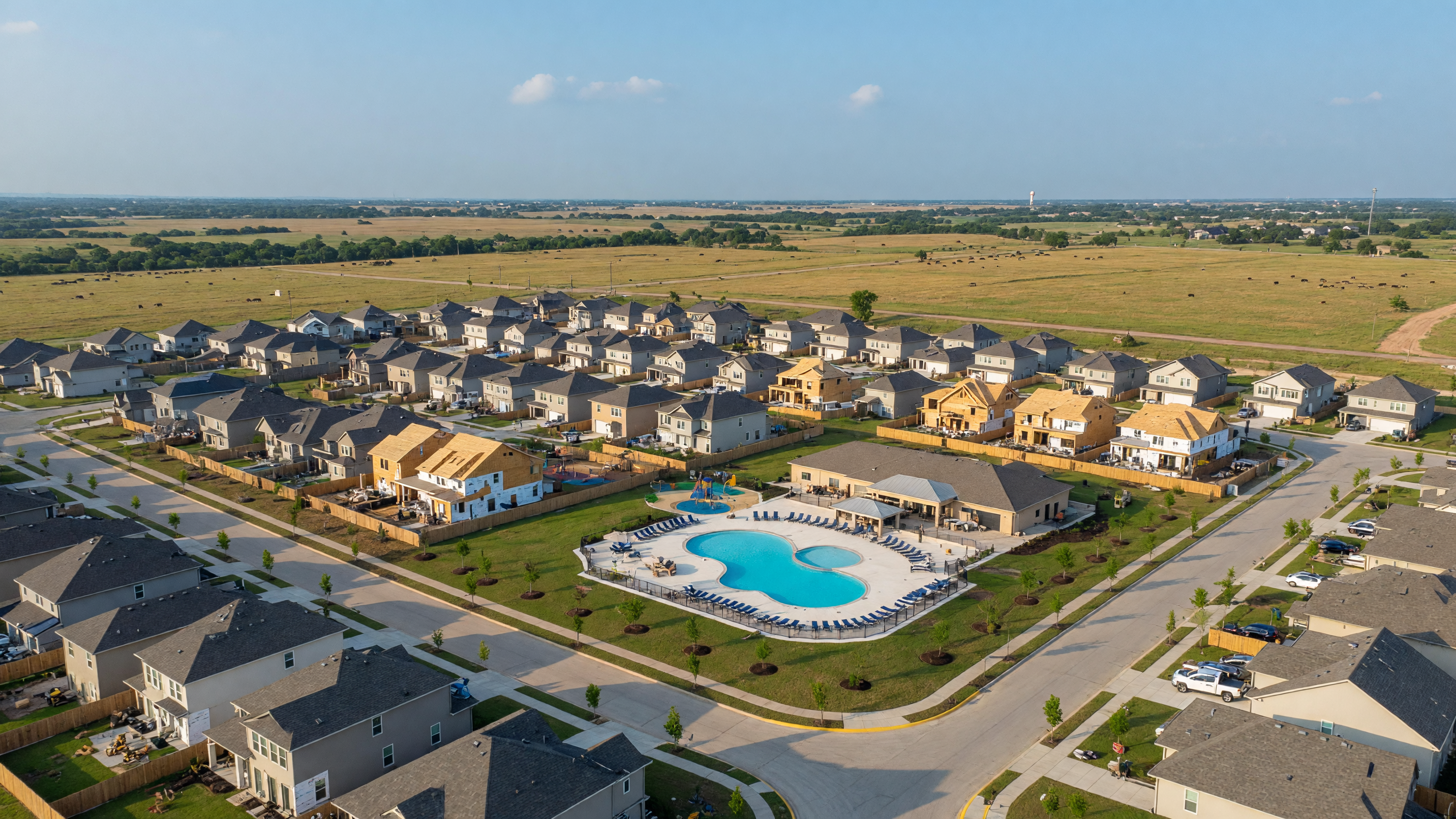
When buyers begin exploring new construction in Denton County, the first number they see is the base price. A home "from the $400Ks" or "starting at $499,990" sets the frame of reference. But the base price is not the total cost of the transaction, and it is not the full cost of ownership. Lot premiums, upgrades, closing costs, property taxes across every taxing entity that serves the property, HOA and special-district assessments, insurance, and ongoing maintenance all sit on top of it.
As the Real Estate Broker of Covenant Heritage Realty, I help buyers identify and compare the cost components of competing new-construction options. I coordinate with lenders, insurance professionals, tax resources, and other specialists so every figure is property-specific rather than generic. This guide is a framework for thinking through those costs in October 2026. It is not tax, legal, insurance, or lending advice, and it is not a substitute for the quotes, estimates, and disclosures you should obtain for the actual home and loan scenario you are considering.
Last Reviewed: October 22, 2026. Tax rates, appraised values, exemptions, insurance premiums, HOA assessments, and lender terms all change over time. Verify current figures for the specific property before making decisions.
Quick Answers
Short, direct answers to the questions buyers ask most about the true cost of new construction in Denton County, based on the verified details in this article. Tax rates, assessments, and exemptions vary by property, so verify the specifics for the exact address.
-
Are new homes taxed at the purchase price?
Not automatically. The appraisal district sets an opinion of market value, which may be above, at, or below the price you paid. Newly completed improvements are added to the tax roll at market value as of the January 1 appraisal date, and that value is subject to protest.
-
Why can the first full tax bill increase?
Texas appraises property as it exists on January 1. A home completed during the year is typically added at partial completion or land value that year, then the completed improvement is added at full market value the following January 1, which is why the first full-year bill can jump.
-
Do MUD or MMD rates decrease over time?
There is no predictable, universal pattern. District tax rates are adopted periodically and can change based on debt service, operations, and changes in appraised values. Verify the current adopted rate for the specific tax year.
-
How do I get a homestead exemption on a new construction home?
File a residence homestead application with the appraisal district as soon as the home becomes your primary residence. The 10% homestead appraisal cap generally takes effect January 1 of the tax year following the year the property qualifies.
What Costs Are Not Included in a Builder's Base Price?
The base price typically reflects the least expensive homesite in a given collection and the builder's standard finishes. It is not an all-in price. The hidden costs of new construction in Texas are the line items that never appear in the headline price. The costs below are usually separate line items, and several of them are the largest sources of budget movement in a new-construction purchase:
- The homesite itself. Most collections carry a lot premium over the base homesite price, and the premium varies by builder, collection, and lot.
- Structural and design-center selections. Floor-plan options, structural changes, and finish upgrades are priced above the base model.
- Closing costs and lender fees. Title, escrow, appraisal, points, underwriting, and other loan costs are paid at closing and are generally not part of the base price.
- Property taxes and special-district assessments. These are separate obligations tied to the property and its taxing entities, not the builder's price.
- HOA dues and any MMD, WCID, or PID assessments. Recurring amounts set by the homeowners association or by the district that serves the property.
- Homeowners insurance. A separate premium you pay to an insurer you select.
- Utilities and maintenance. Monthly services and the ongoing cost of caring for the home and yard.
- Items that vary by builder. Landscaping, irrigation, fencing, garage door openers, window treatments, and appliance packages are included by some builders and charged separately by others.
The contracts differ from builder to builder, so what the base price includes and excludes is a contract question, not a general rule. Read the purchase agreement, the builder's cost estimate and disclosure documents, and the homesite selection sheet, and ask directly which items are included and which are additions.
How Property Taxes Work on a New Construction Home in Texas
Texas has no state income tax, and local services such as schools, roads, and public safety are funded primarily through property taxes. For new-construction buyers, two things matter most: how the home's value lands on the tax roll, and which taxing entities set rates for the specific property.
Texas appraises property as of January 1 of each tax year. A home still under construction on January 1 is added to the roll based on its percentage of completion as of that date. A home completed during the year typically draws an initial bill based on the land plus the improvement at its partial value, and then the completed improvement is added at full market value the following January 1. That is why a newly completed home can experience a significant appraisal change when the completed improvement is first added to the tax roll. It is a function of appraisal timing and valuation, not a built-in penalty for new construction.
The appraised value is the appraisal district's estimate of market value as of the January 1 appraisal date, which is a separate figure from the purchase price you agree to pay. For new construction, the value that lands on the roll depends on the property's completion as of that date: a home still under construction is valued at its percentage of completion, and the completed improvement is added at full market value the following January 1. The district's opinion may be above, at, or below the price you paid, depending on the market and the evidence the district uses. A new home is not automatically taxed at the full purchase price, and a new home does not automatically carry a higher tax bill than a comparable resale property.
Key Property Tax Facts for Denton County Buyers
The municipal rate is only one component of the total burden, not the total. The combined rate for a specific Northlake property also includes Denton County, the school district that serves the address (Northwest ISD in some sections, Argyle ISD in others), Denton County Emergency Services District No. 1 in some areas, and, for some communities, a municipal management district assessment. Community guides on this site show combined rates in Northlake around 1.6 percent for some properties in Northwest ISD without a special-district layer, and above 2.4 percent for communities that carry a MMD assessment, which demonstrates why the property-specific combined rate, not the city rate, is the number that matters.
How Escrow Works: Taxes and Insurance in Your Monthly Payment
For most buyers, property taxes and homeowners insurance are not separate bills paid once a year. They are folded into the monthly mortgage payment through an escrow account managed by the mortgage servicer, which is why the payment is described as principal, interest, taxes and insurance. The Consumer Financial Protection Bureau (CFPB) explains that an escrow or impound account is set up by the mortgage lender, funded by a portion of each monthly payment, and used to pay property taxes and insurance on the borrower's behalf (accessed October 2026).
The payment breaks down into the principal and interest that repay the loan, plus the escrow amount, which typically collects roughly one-twelfth of the annual property tax bill and one-twelfth of the annual homeowners insurance premium each month. Closing includes an initial escrow deposit, and once a year the servicer analyzes the account, so when taxes or insurance premiums change, the monthly escrow amount is adjusted (CFPB, principal and interest payment vs. total monthly payment, accessed October 2026).
This is where the figures on this page become a monthly number. The combined rate for the specific property, applied to the assessed value, produces the annual tax bill. Not every obligation is billed the same way: ad valorem district taxes (such as a MUD, MMD, or WCID property tax) may appear on the property-tax bill, while PID assessments, HOA dues, and utility charges can be billed or collected separately by the district, the association, or the utility provider. Whether a given amount is escrowed by your mortgage servicer depends on how that obligation is billed and collected, so for the specific property verify the collecting entity, billing schedule, balance, and payment method. On new construction, the first bills can reflect land or partial completion, and when the completed value lands on the tax roll the escrow account is re-analyzed and the payment adjusts; filing your residence homestead exemption reduces the school maintenance and operations share of the bill and the escrow amount that goes with it. The property record at the Denton Central Appraisal District helps identify the appraisal and taxing information for an address, though it may not show every HOA obligation or separately billed assessment (Denton Central Appraisal District, accessed October 2026).
What can be escrowed? For most buyers, property taxes and homeowners insurance are the two items folded into the monthly mortgage payment through an escrow account managed by the mortgage servicer. Some servicers can also collect HOA dues or an assessment as part of the payment, but that is not automatic: it depends on how the obligation is billed and whether the servicer offers that service. An amount that is billed separately, such as a PID assessment billed by a district or HOA dues billed by the association, is not escrowed unless you arrange it. Ask your lender and the billing entity directly what will be escrowed for the specific loan and property.
Monthly Costs Beyond the Mortgage: A Worked Framework
The question almost every new-construction buyer asks is "what will the monthly payment actually be?" The mortgage is only part of it. Treat the monthly figure below as an estimate built from property-specific inputs, not a quote: every line must be obtained or verified for the actual home and loan scenario. The practical monthly carry on a Denton County new home is the sum of mortgage costs, property taxes, homeowners insurance, HOA dues, any separately billed assessment, and utilities. Keep each line separate so a fee is not counted twice: confirm whether an assessment is billed with the tax bill, by the district, or by the association before adding it to more than one line.
- Mortgage costs, monthly. Principal and interest at the quoted rate for the specific loan amount, from a written Loan Estimate. This line does not include taxes or insurance.
- Property taxes, monthly. Take the combined rate for the exact property, apply it to the expected taxable value, and divide by 12. Illustrative example only: a $600,000 taxable value at a 2.2 percent combined rate (before exemptions) is about $13,200 a year and about $1,100 a month; the same value at 2.6 percent is about $15,600 a year and about $1,300 a month. A residence homestead exemption lowers the bill and the escrow amount.
- School-district rates vary by address and by tax year. The rate that applies is the one the district adopted for the property-tax year, which is a separate matter from the district's fiscal year. Recent adopted rates give a sense of the spread: Denton ISD's adopted rate for tax year 2026 is $1.1528 per $100 (adopted September 22, 2026, down from $1.2069 for tax year 2025), Lewisville ISD's adopted rate for tax year 2026 is $1.0778 per $100 (adopted August 27, 2026, its lowest rate since at least 1999, down from $1.1178 for tax year 2025), and Argyle ISD's most recently verified adopted rate is $1.1727 per $100 for tax year 2025, with the current tax year's rate to be confirmed on the district's tax-rate page. These are school rates only, adopted for specific tax years; verify the current adopted rate for the district that serves your address.
- Municipal and special-district layers. The municipal rate is one more layer, and communities with a MMD, MUD, WCID or PID add another. As a current example, Northlake Municipal Management District No. 1 and Northlake Municipal Management District No. 2 each adopted $0.705 per $100 for tax year 2026. Combined rates for specific Northlake and Argyle communities are listed in the comparison articles on this site, from about 2.34 percent for Pecan Square (2024) to about 2.52 percent for The Ridge and around 2.6 percent for parts of Canyon Falls, always to be re-verified for the current tax year.
- Insurance, monthly. A property-specific quote divided by 12; premiums vary by coverage, carrier and replacement cost, so there is no reliable substitute for a quote on the finished home.
- HOA dues, monthly. The confirmed community amounts below convert directly to monthly figures. Canyon Falls is $608 per quarter as of January 1, 2026 (about $2,432 per year, covering the base HOA assessment, TV and internet, and landscape services); Pecan Square is about $2,260 per year for standard single-family lots, billed semi-annually, including fiber internet; Harvest is about $2,070 per year for most single-family homes, billed in two semi-annual payments; Landmark by Hillwood is $1,600 per year, paid in two semi-annual payments. Each is subject to change and may differ for a specific home type, so verify the current amount in writing. A PID assessment is a separate obligation: it is not part of HOA dues, and whether it is billed with the tax bill, by the district, or separately must be verified for the specific property.
- Utilities. Confirm water, sewer, electric, gas and internet providers and typical bills for the specific community; some master plans bundle internet or front-yard maintenance into HOA dues, so check before adding the same service to two lines.
The framework to use: monthly total equals principal and interest, plus one-twelfth of the annual tax bill, plus one-twelfth of the annual insurance premium, plus the monthly HOA dues, plus any separately billed assessment (such as a PID), plus the monthly utility bundle. Compare that total across the homes on your shortlist, because a lower base price can carry a higher monthly total once assessments are added.
Can I Get a Homestead Exemption the Year I Buy a New Home in Texas?
Generally, yes for the year you buy, with an important condition. Under Texas Comptroller guidance, a qualifying buyer who acquires and occupies a residence after January 1 may be able to receive the general residence homestead exemption for the applicable portion of that same tax year, if the previous owner did not receive the same exemption for that property in that year. This rule, in effect since January 1, 2022, means buyers are no longer required to wait until the following tax year in this situation. You file an application with the appraisal district, and once it is approved the exemption can apply from the start of the year.
The 10 percent residence-homestead appraisal limitation, which caps year-over-year growth in the appraised value of a homestead, generally takes effect January 1 of the tax year following the year the property qualifies for the exemption. In other words, the cap protects increases in later years; it does not cap the first assessment of a newly completed improvement when it is added to the roll.
Exemption eligibility and the appraisal cap are separate rules. Whether a property qualifies for the residence homestead exemption is decided by the appraisal district under state law, and the 10 percent cap limits year-over-year growth in the appraised value once the property is a qualified homestead. For the specific situation, confirm both rules with the appraisal district and the Texas Comptroller's property tax guidance.
File the homestead application as soon as the home becomes your primary residence, and ask the appraisal district what documentation it requires. The exemption reduces the portion of the tax bill tied to the school district's maintenance and operations rate, so the timing of your application can affect the part of the year you benefit. This article does not provide tax advice; for your specific situation, confirm the rules with the appraisal district or a tax professional.
Does a Lower City Tax Rate Mean a Lower Total Tax Bill?
Not necessarily. The city or town rate is a single line in a combined rate that also includes the county, the school district, and any special districts serving the property. A community with a low municipal rate can still carry a higher total rate if it sits in a school district with a higher rate or if a municipal management district or other assessment layer applies to that section.
The total bill also depends on the assessed value, which varies with the appraised market value of the specific home and lot. When comparing communities, compare the combined rate for the specific property, the appraised-value expectation, and the assessment layers, rather than comparing only the municipal rates.
What Is a MUD, MMD, WCID or PID?
Special districts and assessment districts are how much of the infrastructure in newer North Texas communities gets built and maintained. They are separate from a homeowners association, and each has a different legal structure. Knowing which one applies to a property tells you how the obligation is created, how it is collected, and where to look for current rates. Financing structures vary by development: some communities are served by municipal utilities, others by a MUD or WCID, and some carry MMD or PID layers. There is no single pattern, so the district layers for the specific property are a verification task, not an assumption.
Municipal Utility District (MUD)
A MUD is a political subdivision created under Texas Water Code Chapter 54, typically by the Texas Commission on Environmental Quality or the Legislature. It provides water, sewer, drainage, and sometimes roads and parks, most often in newer or unincorporated areas. A MUD issues bonds to finance infrastructure and repays them through property taxes levied on property inside the district. It is governed by a board of directors that is initially appointed and later elected by district voters.
Water Control and Improvement District (WCID)
A WCID is created under the Texas Water Code and provides similar utility services, typically water, wastewater, and drainage, financed through district bonds repaid with property taxes. Like a MUD, it is overseen by the Texas Commission on Environmental Quality and governed by a board of directors. The practical effect for a buyer is similar: the district layer adds to the property tax obligation for the property inside the district.
Municipal Management District (MMD)
An MMD is created under Texas Local Government Code Chapter 375, usually by a special act of the Legislature. Its purpose is broader than utilities: promoting and maintaining commerce, employment, transportation, housing, parks, tourism, public safety, and supplemental services such as streetscapes and landscaping. An MMD can be funded through property taxes, assessments, and in some cases sales taxes, and it is governed by a board of directors made up of property owners or their appointees. MMD assessments can add a meaningful layer to the cost of homes in communities where one has been created.
Public Improvement District (PID)
A PID is not a separate political subdivision. It is a financing mechanism created by a city or county under Texas Local Government Code Chapter 372, at the request of property owners, that levies special assessments on properties inside the district to pay for authorized public improvements and services above the level the city or county otherwise provides. Improvements can include roadways, sidewalks, landscaping, parks, lighting, parking, and public safety. The structure, assessment methodology, duration, and annual amount vary by district, so the terms must be verified for the specific property. A PID is not an HOA amenity fee, and it is not interchangeable with HOA dues.
District tax rates are adopted periodically and can change based on debt service, operations, changes in appraised values, and other factors. There is no predictable, universal schedule on which MUD, MMD, or WCID rates decline as bonds are repaid. In Denton County, tax records show that Northlake Municipal Management District No. 1 and Northlake Municipal Management District No. 2 each adopted a rate of $0.705 per $100 of assessed valuation for tax year 2026 (Denton County Truth in Taxation, accessed October 2026). As a purely illustrative point using that published tax year 2026 figure, a MMD layer at $0.705 per $100 on a $500,000 assessed value equals about $3,525 per year for that layer alone, before county, municipal, school district, and any other layers. That arithmetic is an example, not a quote; current adopted rates must be verified for the property and tax year you are considering. How each obligation is billed and collected also varies: ad valorem district taxes may appear on the property-tax bill, while PID assessments, HOA dues, and utility charges can be billed separately by the district, the association, or the utility provider. For the specific property, verify the collecting entity, billing schedule, balance, and payment method.
The practical takeaway: a single community can contain multiple districts, and two homes in the same master plan can sit in different taxing situations. The way to handle it is to identify the exact entities for the specific address and verify current rates through Denton County tax and appraisal records.
How Do I Find the Total Tax Rate for a Denton County Property?
Because the combined rate is assembled from several entities, it has to be verified for the specific property rather than assumed from a city or community name. Here is where to look:
- Ask the builder in writing. The sales team can identify the school district, municipal boundaries, and special districts for the specific homesite, and can provide an estimated tax figure.
- Check appraisal district records. The Denton Central Appraisal District maintains property-specific appraisal records that show the taxing entities for each account (accessed October 2026).
- Check county tax rate records. Denton County publishes adopted rates for the county, cities, school districts, and special districts, so you can confirm the adopted rate for each entity (Denton County Truth in Taxation, accessed October 2026).
- Confirm school district assignment for the address. Attendance boundaries can change and vary by section within a community.
- Confirm special-district status. Ask whether the property lies in a MUD, WCID, MMD, or PID, what the assessment methodology is, and what the current balance and annual amount are.
- Get a written estimate. A title company or the builder can estimate taxes for closing, and the first full-year bill will reflect the completed improvement on the roll.
New Construction HOA Fees: What They Cover and Where to Verify Current Amounts
A homeowners association is a private, contractual association, not a taxing entity. HOA dues are set by the association's governing documents and board, and they pay for common-area maintenance, amenities, community standards enforcement, and management. In some communities they also bundle services such as fiber internet or front-yard maintenance. HOA dues are distinct from MUD, MMD, WCID, and PID obligations, which are created by statute or by a city or county and are collected through the property tax or assessment process.
HOA assessments can change, and buyers should verify the current amount and what it covers through the community's official HOA or community sources. The amounts below are current published figures as of the sources noted; each is subject to change, and the applicable amount may differ for a specific homesite or home type.
Current Published HOA Information (verified October 2026; confirm in writing before purchase)
When comparing HOA fees across communities, look at what the dues include and how increases are determined, not just the annual dollar amount. Ask for the current dues in writing, ask whether an increase has been approved, and confirm whether the amount applies to the specific home type you are buying. For deeper community context, see the Pecan Square, Harvest, Canyon Falls, Landmark by Hillwood, and The Ridge at Northlake community guides on this site.
Lot Premiums: Why Homesite Pricing Varies
The base price in a collection typically applies to a standard homesite. Premium homesites carry an additional lot premium, and the amount varies substantially by builder, collection, and individual homesite. There is no single range that applies across communities, so the right approach is to compare the actual homesite pricing sheets for the builders and phases you are considering.
A lot premium typically reflects a combination of factors: lot size and frontage, orientation, adjacency to green space or other homes, privacy, road exposure, views, topography, drainage, easements, utility placement, and the potential for future development nearby. Each factor affects how the lot serves you, and the premium should be evaluated against how much the lot improves your daily use of the home.
A premium lot does not automatically hold its value better than a standard lot. Resale value depends on future comparable sales and market conditions when you sell, and preferences change. Evaluate the premium lot against relevant comparable sales in the community, not against an assumption that greenbelt, corner, water-view, or larger homesites always appreciate more.
As one current example, published comparisons on this site show Pecan Square's 50-foot lot product starting around $499,990, while 100-foot estate lots range up to roughly $1.2 million or more. The difference between those products is not almost entirely lot size: the 100-foot collections can also differ in home size, specifications, floor plans, and builder product. Compare the whole package, not just the lot width.
Builder Upgrades: Cost, Function, and Resale Considerations
Builder pricing is built on a base model, and the design center is where the cost of the home grows. How much you spend there is a personal decision driven by the builder's pricing, the base inclusions in the home you chose, and your budget. There is no universal list of upgrades that always justify their cost, and no average design-center spend applies across communities. Instead, organize upgrade decisions by what they cost, how they function, and how hard they would be to change later.
Hard-to-Change Structural Choices
Garage configuration, electrical panel capacity and wiring, plumbing rough-ins, foundation and slab options, stairwell placement, and load-bearing wall locations are embedded in the home during construction. Changing them after closing typically means structural work, drywall repairs, and significant cost. If a feature in this category matters to you, it deserves the most careful consideration during the build. See the New Construction Upgrades guide for a detailed breakdown of these options.
Options Worth Comparing During Construction
Cabinetry configuration, flooring, countertops, tile, trim, paint, and built-ins can be done during construction or later. Compare the builder's price, including any change fees, against quotes from local contractors for the same scope. Neither route is universally better; the right answer depends on the builder's pricing, your timeline, and your tolerance for post-closing projects.
Items Often Practical After Closing
Light fixtures, smart-home devices, appliances, window treatments, and landscaping are usually straightforward to handle after move-in, giving you control over timing, price, and quality. Builder pricing on these categories often carries a premium, so they are good candidates to defer unless the builder's price or a credit makes the convenience worthwhile.
Every upgrade financed through the builder increases the loan amount, which affects the monthly payment and, depending on the transaction, the tax-assessed value and mortgage insurance. Set an upgrade budget in the context of your total cash flow, including down payment, closing costs, moving expenses, and an emergency reserve, and get itemized pricing before the design center appointment.
Insurance: Get a Property-Specific Quote
Homeowners insurance premiums in Texas vary by location, home size, construction type, coverage levels, carrier, and the property's loss and claims history. No generic annual premium range applies to new construction in Denton County, and new construction is not automatically cheaper to insure. Modern building standards can influence how a carrier prices wind, hail, and structural risk, but the only reliable number is a quote for the specific home.
Obtain an actual insurance quote for the specific home before the applicable contract deadline, typically within your option period or as the builder contract allows. Ask how the quote treats the dwelling replacement cost, deductibles, and wind and hail coverage, and confirm the quote is based on the finished home you are buying, including any upgrades that change replacement cost.
Upfront Costs vs. Ongoing Ownership Costs
New-construction costs divide into what you pay to acquire the home and what you pay to own it. Keeping the two lists separate makes it easier to compare communities on the same basis.
Paid before or at closing. Depending on the transaction, these may include:
- Earnest money
- Builder deposits
- Option and design-center deposits
- Down payment
- Points and lender fees
- Closing costs (title, escrow, appraisal, recording)
- Prepaid taxes and insurance
- Initial escrow funding
Deposit and option structures vary by builder, so confirm the requirements and refundability in writing.
Recurring obligations you carry each month and each year:
- Principal and interest
- Property taxes
- HOA dues
- Special-district assessments (MUD, MMD, WCID, PID)
- Homeowners insurance
- Mortgage insurance, if applicable
- Utilities
- Maintenance and repairs
The True Cost Worksheet: Inputs to Gather for Your Actual Scenario
The most reliable way to compare new-construction options is to build a worksheet from property-specific inputs, not from generic assumptions. Treat the worksheet below as a data-gathering checklist. Every value must be obtained for the actual property and loan scenario you are considering; lender rates, APRs, points, tax rates, assessments, and insurance quotes change and vary by address.
- Purchase price for the specific home and homesite
- Lot premium from the builder's homesite pricing sheet
- Structural and design selections from your itemized design-center pricing
- Down payment for your loan program
- Current lender rate and APR from a written Loan Estimate
- Points and lender fees from the same Loan Estimate
- Estimated principal and interest at the quoted rate
- Combined property-tax rate for the specific property, verified through Denton County and appraisal district records
- HOA assessment from the community's official HOA information
- MUD, MMD, WCID, or PID obligations, including assessment methodology, duration, and current annual amount
- Homeowners insurance quote for the specific finished home
- Mortgage insurance, if applicable to your loan program
- VA funding fee or FHA MIP, where applicable to your loan
- Closing costs, prepaid taxes and insurance, and initial escrow funding
- Utilities and maintenance considerations for the home size and lot
Once the worksheet is complete for two or more communities, compare them line by line. The community with the lower monthly housing payment is not automatically the lower-cost community once taxes, assessments, HOA dues, and insurance are included. I help buyers gather these inputs and coordinate with lenders, insurance professionals, and tax resources so the comparison is built on property-specific figures rather than assumptions.
How Builder Incentives Affect the True Cost of a Home
Builder incentives, such as closing-cost credits, rate buydowns, and design-center allowances, are common in Denton County new construction. Their value depends on the net effect on your total cost. A credit is worth what it does to your out-of-pocket costs and your financed amount, and a rate buydown is worth what it does to the payment over time, which depends on the rate being bought down from and the pricing of the home itself.
Evaluate incentives as part of the full transaction: compare the total price, financing terms, and credits against the same home without the incentive, and against a resale or another community on the same basis. An incentive conditioned on using the builder's preferred lender should be compared against an outside lender's written offer to see which combination is genuinely lower.
Should I Compare the Builder's Lender With Outside Lenders?
Yes. Get written Loan Estimates from the builder's preferred lender and from one or more outside lenders, and compare them line by line: interest rate, APR, points, lender fees, buydown terms, lender credits, and any builder incentive conditioned on financing. Interest rates change, so use the current quotes you receive rather than assumptions, and make sure each estimate reflects the same loan amount, down payment, and property.
The lowest headline rate is not automatically the best offer if fees, points, or the incentive conditions offset the difference. The goal is the lowest true cost for your scenario, and comparing written estimates is the way to find it.
What to Ask Before Signing a New-Construction Contract
Before you sign a purchase agreement on any new-construction home in Denton County, these questions protect your financial position:
1. What is the full list of taxing entities and current adopted rates for this specific property?
Get the combined rate, not just the city rate, verified for the address. Include the county, school district, municipal, and special-district components, and confirm which school district serves the homesite.
2. Is this property in a MUD, MMD, WCID, or PID?
If so, what is the assessment methodology, the duration of the obligation, the current balance, and the current annual assessment? Ask for this in writing and verify it through Denton County and appraisal district records.
3. What are the current HOA dues, what do they cover, and how are increases determined?
Get the current annual amount in writing, confirm whether it applies to your home type, and ask about the process the association uses to set future assessments.
4. What does the base price include, and what does it not include?
Landscaping, irrigation, fencing, garage door openers, window treatments, and appliance packages vary by builder. Review the contract, the cost estimate, and the homesite sheet so your budget matches the finished product.
5. What are the deposit, option, and design-center requirements?
Ask about the amounts, when they are due, and whether and when they are refundable. Deposit and option structures vary by builder.
6. What incentives apply, and are they conditioned on the builder's lender?
Get the incentive terms in writing, including any financing conditions, and compare the net cost against an outside lender's written offer.
7. Can I get a written tax estimate and an insurance quote before the applicable deadlines?
Ask for the builder's estimated tax figure and obtain an actual insurance quote during your option period, so the ongoing costs are known before you are committed.
8. What are the construction timeline, closing-cost estimate, and cancellation terms?
Understand the estimated completion date, the lender's rate-lock windows, the estimated closing costs and prepaids, and what happens if you cancel. Read the builder contract carefully before signing.
Representation matters here. Under TREC rules effective January 1, 2026, a written agreement is required before a license holder shows residential property, or before presenting an offer when no property will be shown. The agreement may be a representation agreement or an eligible showing-only/non-representation agreement, so a buyer is not required to hire an agent. The builder's on-site sales representative represents the builder, not you. Review representation terms before touring or registering with a builder, and see TREC's guidance on what changes in 2026 about buyer representation (accessed October 9, 2026). For more on how this works, read the New Construction Buyer Representation page.
The Bottom Line
New construction in Denton County offers modern homes in planned communities across Argyle, Northlake, Flower Mound, Denton, Justin, and Hickory Creek. The true cost of that home, however, extends well beyond the base price on the builder's website. Property taxes across the entities that serve the property, HOA and special-district assessments, lot premiums, upgrades, insurance, closing costs, and ongoing ownership costs all factor into the decision. Buyers focusing on Flower Mound, where established resale and western new construction compete in the same buyer searches, can see how those costs compare in the moving-to-Flower-Mound relocation guide.
The framework in this article is designed to help you compare options on the same basis: build the worksheet from property-specific inputs, verify current rates and assessments through authoritative sources, and get written quotes for the loan, insurance, and taxes that apply to the actual home. That is the difference between comparing sticker prices and comparing true costs.
If you are evaluating new-construction options in North Texas, I can help you identify the cost components of competing communities and coordinate with the lenders, insurance professionals, and tax resources who provide the property-specific figures.
Theresa De La Rosa
Broker, REALTOR®
Covenant Heritage Realty, LLC | In DFW Living Group
Sources and How to Verify These Figures
The figures in this article carry their sources inline, and the official sources below were reviewed October 9, 2026. Rates, appraised values, exemptions, assessments, HOA dues and lender terms all change, so every figure must be re-verified for the specific property and tax year you are considering.
- Consumer Financial Protection Bureau. Mortgage payment and escrow basics: What is an escrow or impound account? and principal and interest payment vs. total monthly payment (accessed October 2026).
- Texas Comptroller of Public Accounts. Property tax structure and exemptions: Property Tax System Basics and Property Tax Exemptions (accessed October 2026).
- Denton Central Appraisal District. Local appraisal records, exemptions and taxing entities: dentoncad.com and the DCAD property search (accessed October 2026).
- Denton County Tax Assessor-Collector. Tax bills, payments and adopted rates for every taxing entity: Tax Assessor-Collector and Truth in Taxation adopted rates (accessed October 2026).
- School district adopted rates. Denton ISD's adopted rate for tax year 2026 of $1.1528 per $100 (adopted September 22, 2026, down from $1.2069 for tax year 2025): dentonisd.org and the site's summary article; Lewisville ISD's adopted rate for tax year 2026 of $1.0778 per $100 (adopted August 27, 2026; $1.1178 for tax year 2025): lisd.net; Argyle ISD's most recently verified adopted rate of $1.1727 per $100 for tax year 2025, with the current tax year's rate to be confirmed on the district's tax-rate page. All accessed October 9, 2026; school rates are adopted for specific tax years and change annually.
- Texas Real Estate Commission (TREC). 2026 buyer representation changes: What Changes in 2026 About Buyer/Tenant Representation in Texas (accessed October 9, 2026).
- Community HOA sources. Canyon Falls master assessment as of January 1, 2026 (community HOA information); Pecan Square HOA information, verified October 2026 (Hillwood's Pecan Square HOA information page); Harvest HOA dues for 2026 (Harvest HOA published dues documents); Landmark by Hillwood HOA dues (Landmark's FAQ page). All accessed October 9, 2026; each amount is subject to change and must be confirmed in writing for the specific home type.
Community HOA amounts referenced above are published community figures attributed in the text and must be confirmed in writing before purchase. This article is educational and is not tax, legal, insurance or lending advice.
Pricing out new construction in Denton County? Get guidance before you register.
I grew up around my family's home-building business, worked in builder marketing and new-home sales, and studied real estate during my MBA. Today, I help North Texas buyers compare homes, builder offers, community costs and construction timelines.
Plan My New-Construction Purchase