
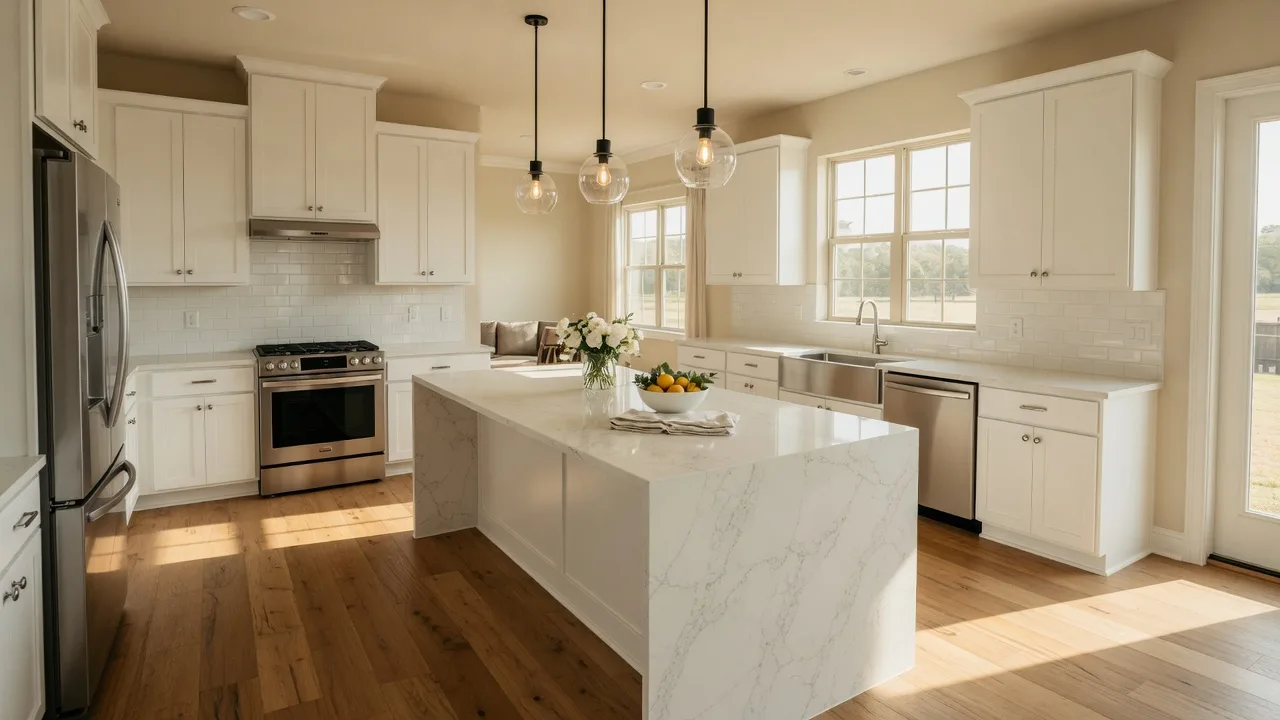
If you are buying new construction in Denton County, the design center visit is one of the most exciting steps in the process. You get to choose the finishes that will define your home for years to come. But behind every upgrade option is a price tag, and knowing which ones are worth the cost depends on the builder, the home, and your specific plans.
As a Real Estate Broker who has worked with buyers across communities including Pecan Square, Harvest, Canyon Falls, and Landmark by Hillwood, I have seen how quickly the design center choices add up. This guide organizes upgrade decisions into three categories so you can evaluate each option on its own merit rather than feeling pressured to say yes to everything.
Last Reviewed: October 22, 2026. Tax credit information reflects current federal law as of this date. Consult a tax professional for personal guidance.
Quick Answers
Short, direct answers to the questions buyers ask most about new-construction upgrades in Denton County, based on the verified details in this article. Pricing and incentives vary by builder, so compare quotes before your design-center visit.
-
What new construction upgrades are worth it?
Upgrades that are difficult or disruptive to change after closing deserve the most serious consideration: structural options, garage configuration, and electrical and plumbing infrastructure. Beyond that, whether a finish upgrade adds value is a personal decision based on budget and lifestyle. There is no universal list that always pays off.
-
Are builder upgrades worth the price?
It depends. Some builder upgrades are priced competitively with retail when you factor in labor and convenience; others carry significant markups. Research retail pricing for the materials and installation before your design-center visit and compare it to the builder's quoted price.
-
Are appliance and light-fixture upgrades worth it from the builder?
Appliance upgrades can be worth it if pricing is competitive and installed convenience matters, but markups on premium appliances are often significant. Light fixtures are almost always more economical to purchase and install independently, since builder fixture pricing tends to carry a substantial premium.
-
Are new-construction energy upgrades tax deductible in 2026?
No. The Energy Efficient Home Improvement Credit (Section 25C) and the Residential Clean Energy Credit (Section 25D) terminated after December 31, 2025, and neither applies to newly constructed homes in 2026. Consult a tax professional for personalized guidance.
-
What should I not spend money on at the design center?
Consider deferring light fixtures, window treatments, smart-home devices, landscaping, and ultra-premium appliance packages until after closing. These items are readily available at retail and straightforward to install later. Set a prioritized budget before you walk in.
A Three-Category Framework for Evaluating Upgrades
Not every upgrade is created equal. Some are exceptionally costly or disruptive to change after closing, while others are simple weekend projects. Understanding which category a potential upgrade falls into is the first step toward making a smart decision. Whether any specific upgrade is worthwhile depends on the builder's pricing, your long-term plans, and the home itself. There is no universal right answer.
Category 1: Upgrades That Are Hard to Change Later
These upgrades involve structural elements, infrastructure, and layout decisions that would be difficult, disruptive, or expensive to modify after construction is complete. If a feature in this category matters to you, it is worth serious consideration during the design phase.
Garage Configuration
The number of bays, bay depth and width, garage door sizes, driveway layout, and any future overhead storage or EV-charging rough-ins are all set during construction. Widening a garage bay, adding a third bay, or changing a driveway configuration after closing typically involves foundation work, slab saw-cutting, and sometimes roof-line adjustments. The scale of structural work makes these changes far more expensive after closing, if they are even feasible on the same lot. Evaluate the garage configuration against the number of vehicles you actually own and the space you need for storage, a workbench, or larger vehicles like trucks or SUVs.
Structural and Electrical Infrastructure
The electrical panel capacity, wiring, conduit runs, and outlet placement are embedded in the walls during construction. Upgrading the panel amperage, adding a sub-panel, or running new circuits for a future EV charger, generator transfer switch, or workshop after closing requires an electrician, drywall repairs, and potentially a service upgrade from the utility. The same is true for low-voltage wiring, structured cable runs, and data conduit. Paying for a larger panel or conduit stubs during the build is often a fraction of the cost of adding them later.
Note the distinction between infrastructure (panels, wiring, conduit) and replaceable devices (outlets, switches, cover plates). The infrastructure matters during construction. The devices can be swapped easily later.
Plumbing Rough-Ins
A plumbing rough-in for a future bathroom, wet bar, outdoor kitchen, or utility sink is inexpensive during the build but prohibitively costly to add after the slab is poured and the walls are closed. If you may want a half-bath in the garage, a basement (where applicable), an outdoor kitchen, or a future laundry-room sink, adding the stub-out during construction preserves the option without committing to the finished fixture.
Foundation and Slab Considerations
The slab determines the home's stability, floor levelness, and resilience to Texas soil movement. Upgrades to the foundation, such as deeper piers, post-tension cable specifications, or thickened-edge slabs, must be made during construction. Once the slab is poured, modifying it requires major structural engineering. If your lot has variable soil conditions or you are building on a slope, the optional structural engineering and foundation upgrades offered by the builder can be worth evaluating, though the builder's geotechnical report and warranty terms should guide the decision.
Stairwell Placement and Load-Bearing Layout
Stairwell location and the placement of load-bearing walls define the home's floor-plan flexibility. Moving a stairwell or altering a load-bearing wall after closing is a structural project requiring engineering, permits, and substantial framing work. The same is true for two-story great-room ceiling heights, window and door opening sizes, and the overall room configuration. If the floor plan does not suit the way your family will actually live, it is worth addressing the layout during the design phase rather than planning to renovate later.
Category 2: Upgrades That Are Practical During Construction
These upgrades involve finishes and features that are convenient to complete during the build but could also be done after closing. Whether it makes sense to do them through the builder depends on builder pricing, change fees, your financing, and your tolerance for post-closing projects. There is no universal verdict.
Cabinetry Configuration Versus Hardware
Cabinet layout, box depth, door style, and drawer configuration are easiest to specify during construction because they affect cabinet box sizing and the trim that surrounds them. Upgrading from 36-inch to 42-inch upper cabinets, adding a pullout pantry, or changing door styles after closing means replacing entire cabinet boxes, which is expensive and disruptive. Cabinet hardware, such as knobs, pulls, and hinges, can be swapped out easily. A practical approach is to upgrade the cabinet configuration through the builder and plan to source hardware independently if you want a different finish or style.
Flooring and Countertop Selections
Flooring installed during construction goes in before the baseboards and cabinets, making it more seamless than a post-closing replacement. Replacing carpet with hard surface later involves moving furniture, removing the existing flooring, potentially adjusting cabinet toe-kicks, and disposing of old materials. These are disruptive and costly, but not impossible. Countertop upgrades follow a similar trade-off: doing them during construction means the builder handles the templating and installation with the rest of the schedule, but you can also replace countertops later as a standalone project. Compare the builder's pricing and change fees against local installer quotes. Neither route is universally better.
Tile, Trim, Paint, and Built-Ins
Tile selections (backsplash, shower surrounds, flooring in wet areas), trim packages (crown molding, baseboard profiles), paint colors and sheen, and built-in shelving or window seats are all feasible during construction. The builder prices these with their own margin and may charge change fees for revisions. Doing these after closing gives you control over materials and labor but adds time and project management. The best route depends on your budget, timeline, and whether you have a contractor you trust for post-closing work. For built-ins, the functional design is what matters -- a simple, well-proportioned built-in from the builder may be more convenient than a custom carpenter after closing, but the opposite can also be true if the builder's price includes a significant premium.
Category 3: Upgrades That Are Easier to Complete After Closing
Some upgrades are straightforward to handle after you move in, giving you the flexibility to spread costs over time and make decisions at your own pace.
Light Fixtures
Builder-grade light fixtures are functional and typically code-compliant, but they are often basic in style. Replacing a light fixture is a simple electrical swap that a licensed electrician or confident homeowner can complete in minutes. The builder may charge two to five times the retail price for upgraded fixtures. Unless the builder offers a credit that makes the upgrade cost neutral, light fixtures are almost always more economical to purchase and install after closing.
Smart-Home Devices
Smart thermostats, doorbell cameras, smart locks, and voice-controlled lighting systems are widely available at consumer electronics stores and through professional installers. Builders typically offer branded packages at a premium. Unless the builder is integrating smart features into the home's wiring in a way that is difficult to replicate later (which is rare for production homes), these devices are generally more affordable and more customizable when sourced independently. Confirm that the builder's base wiring supports the devices you want, and plan to add the smart components after closing.
Appliances
Appliance upgrades are a mixed category. If the builder offers a meaningful credit or if the upgraded appliance package is priced competitively, it can be convenient to select all appliances during the design center visit and have them installed before move-in. However, if the builder's markup is significant (common for luxury brands), buying appliances independently after closing often yields better pricing. A common and sensible approach is to accept the builder's standard appliance package and replace specific appliances (refrigerator, range, dishwasher) over time as budget allows. Builder-grade appliances are generally functional and covered by warranty; a replacement refrigerator purchased later at retail can be a more targeted use of funds.
Window Treatments
Blinds, shades, drapes, and shutters are never part of the base new-construction build. Builders offer them through the design center at retail or near-retail pricing, but you have no obligation to purchase them from the builder. After closing, you can measure each window, compare custom and off-the-shelf options, and install treatments that match your style and budget. This category is entirely under your control after closing.
Landscaping and Outdoor Finishes
Most production builders include a standard landscaping package (front-yard sod, a few shrubs, and an irrigation stub). Upgrades such as full-yard irrigation, patios and walkways, outdoor kitchen components, fencing, and landscape bed design can be done after closing. Doing them later gives you the flexibility to work with a landscape designer or contractor you choose, at your preferred scope and budget. Some communities have HOA landscape requirements; reviewing those standards during your design center visit helps ensure your post-closing plans will satisfy the guidelines.
Lot Premiums: What You Are Really Paying For
One of the largest decisions in a new-construction purchase does not involve a single cabinet or countertop. The lot itself is often a separate line item, and lot premiums can range from a few thousand dollars to six figures in master-planned communities. Understanding what you are paying for -- and what you are not -- is critical.
Lot premiums typically reflect some combination of size (larger lots, wider frontages, deeper setbacks), orientation (south-facing rear exposure for natural light, corner lots with additional yard space), road exposure (cul-de-sac or interior street versus main thoroughfare), view (greenbelt, pond, golf course, or preserve views), topography (level building pads versus sloped lots that require additional foundation engineering), and easements or drainage features that may limit how you can use the yard.
Builders set lot premiums based on their own pricing model, the current phase's demand, and the lot's position within the community. A premium lot in one phase may be priced similarly to a standard lot in the next phase. Comparing lot premiums across phases and across builders in the same community can be instructive.
Paying a lot premium does not automatically produce appreciation. A premium lot's eventual resale value depends on future comparable sales and market conditions at the time of sale. If the community later offers comparable greenbelt lots at lower premiums, or if buyer preferences shift, the premium you paid may not be reflected in a future appraisal. Evaluate a lot premium against how much the lot improves your daily enjoyment of the home, not solely on whether it will be worth more when you sell.
2026 Federal Tax Credits and New Construction: What Buyers Should Know
Important update for 2026: Several federal tax credits that were previously available for energy-efficient home improvements and new home construction have been affected by recent legislation. The following applies to homes acquired or placed in service in 2026:
- Energy Efficient Home Improvement Credit (Section 25C): This credit is not available for newly constructed homes. It applied only to qualifying improvements made to existing homes (owner-occupied primary residences), and it terminated for any property placed in service after December 31, 2025. Buyers of new construction should not expect this credit to apply.
- Residential Clean Energy Credit (Section 25D): This credit for solar panels, solar water heaters, geothermal heat pumps, and similar renewable energy systems terminated after December 31, 2025. It is no longer available for systems placed in service in 2026.
- New Energy Efficient Home Credit (Section 45L): This credit was available to builders, not home buyers, for qualifying new homes. The credit terminates for homes acquired after June 30, 2026. Builders may still claim it for homes acquired by June 30, 2026, but it does not directly benefit the buyer. Buyers should not rely on this credit in their personal tax planning.
No federal tax credits are currently available for new construction energy upgrades in 2026. Consult a qualified tax professional for personalized guidance on your specific situation, as tax laws can change.
Don't Spend the Entire Budget at the Design Center
One of the most common mistakes buyers make is allocating so much to design center selections that little remains for closing costs, moving expenses, immediate post-closing needs, and the first year of homeownership. The design center budget should be established in the context of your total cash flow -- not just the available upgrade dollars on the builder's sheet.
Your priorities should be established before the design center appointment. Consider where upgrade dollars will have the most impact on your daily life and whether those same dollars might serve you better as a cash reserve for a new roof after the builder's warranty ends, a fence or landscaping project, or a higher down payment. The builder's design center consultant is compensated to maximize the sale, not to optimize your overall financial picture.
Before committing to any upgrade, ask: does this leave me with enough cash for closing costs, moving, immediate furnishings, and an emergency reserve? Prioritize structural needs and infrastructure upgrades first, finish upgrades second, and cosmetic upgrades last -- in that order, with the understanding that cosmetic upgrades can almost always wait.
Inspections: What You Should Know in the New Construction Context
Third-party independent inspections can be a valuable part of the new construction process. A TREC-licensed inspector (Texas Real Estate Commission) or a qualified engineer can evaluate the home at key stages -- pre-drywall, final walk-through, and after the first year of occupancy -- to identify issues that the builder's own quality-control inspections may miss. A builder's internal inspections and municipal code inspections are not a substitute for an independent perspective.
Whether you have the right to bring in an outside inspector depends on the terms of your signed builder contract. Unlike the standard TREC One-to-Four Family Residential Contract used for resale homes, builders generally use their own purchase agreements. Some builder contracts specifically permit third-party inspections; others do not, or limit when they can occur. Your agent can help review the contract language before you sign so you understand your inspection rights.
If you do schedule independent inspections, coordinate timing carefully. The pre-drywall stage is the most valuable window because the framing, electrical, plumbing, and mechanical systems are visible. The final walk-through focuses on finishes, trim, and systems operation. Post-closing inspections under the builder's warranty, including the one-year warranty inspection, are also useful for catching issues that emerge after regular occupancy.
Note that Texas Property Code Chapter 27 (the Residential Construction Liability Act) outlines the process for pursuing claims if defects appear later. That process requires written notice and an opportunity for the builder to inspect and repair. An independent inspection can document conditions that may become relevant under that process, though the specific inspection rights, timing, and remedies are determined by your signed contract and applicable law.
This is not legal advice. For questions about inspection rights, contract language, or defect claims, consult a real estate attorney. Your agent can help you understand what is typical for the specific builder and community you are considering.
Builder Upgrade Versus After-Closing: A Comparison
The table below summarizes the key trade-offs between doing upgrades through the builder at the design center and completing them independently after closing. No single approach is universally better; your decision depends on your specific builder, budget, timeline, and personal preference.
| Factor | Builder (Design Center) | After Closing |
|---|---|---|
| Cost | Typically higher than retail; builder marks up materials and may add change fees | Retail pricing plus contractor labor; may be lower overall or comparable depending on scope |
| Convenience | Handled during the construction timeline; no project management needed | Requires scheduling contractors, managing permits, and living through disruption |
| Financing | Financed into the mortgage, increasing long-term monthly payment | Out-of-pocket; uses cash but does not increase mortgage or property tax basis |
| Warranty | Covered by the builder's workmanship and structural warranty | Covered by the contractor's own warranty; builder may not warranty altered work |
| Change Fees | Builder may charge a change order fee for revisions after contract signing | No change fees; you control scope and timing entirely |
| Timing | Completed before move-in; no post-closing disruption | Can be done at your own pace; disrupts occupancy during the work |
Theresa's Six-Question Framework for Every Upgrade
Before selecting any upgrade, walk through these six questions. They are designed to help you separate genuine needs from design-center excitement. The answers will not point to one universal conclusion, but they will clarify which options deserve your budget and which are easier to defer.
1. Does this fit how you will actually live in the home?
A covered patio sounds appealing, but will your family use it in the summer heat? A media room may feel essential in the model home but sit unused. Be honest about your actual daily routines, not the version of yourself you imagine living in a model house.
2. What does the builder charge versus the after-closing cost?
Get quotes from local contractors for the same scope of work before your design center appointment. Some builder upgrades are priced competitively relative to retail; others carry significant markups. Knowing both numbers helps you decide whether convenience or cost savings matters more.
3. Is it hard or disruptive to change later?
Category 1 upgrades (structural, infrastructure, foundation) are far more expensive to address after closing. Category 2 upgrades (finishes) are possible either way. Category 3 upgrades are straightforward later. Let the category guide your priority.
4. Does it affect function or systems rather than only appearance?
An upgraded electrical panel improves function and safety. A specific tile pattern in the shower affects appearance only. When budget is tight, prioritize function first. Cosmetic upgrades can be addressed later with less financial pressure.
5. What does it do to the monthly payment considering financing?
Every dollar spent through the builder increases your loan amount, which increases your monthly payment, property taxes, and mortgage insurance if applicable. A $30,000 upgrade adds to the loan principal and to the tax-assessed value. Run the numbers before committing.
6. Do you have the cash flow after closing costs?
Design center selections are typically due before closing. After you pay the upgrade costs, plus closing costs and down payment, do you have enough cash reserve left for moving expenses, immediate furniture, basic tools, and an emergency fund? A design center selection that compromises your cash position is not worth it, no matter how appealing the feature.
These questions are a decision-making framework, not a checklist of guarantees. Every buyer's situation is different, and what is right for one family may not be right for another. The goal is to make intentional, informed choices rather than reactive ones.
Frequently Asked Questions
What new construction upgrades are worth it?
Whether an upgrade is worthwhile depends on the builder's pricing, your plans for the home, and the specific feature. In general, upgrades that are difficult or disruptive to change after closing -- structural options, garage configuration, electrical and plumbing infrastructure -- deserve the most serious consideration. Beyond that, whether a finish upgrade adds value for you is a personal decision based on budget and lifestyle. There is no universal list of upgrades that always pay off.
What upgrades are hard to change after closing?
The upgrades most costly and disruptive to change later include garage configuration (number of bays, width, depth), electrical panel capacity and wiring, plumbing rough-ins, foundation and slab options, stairwell placement, and load-bearing wall locations. These are structural or infrastructure decisions that require significant construction work and permitting to modify once the home is complete.
Are builder upgrades worth the price?
It depends. Some builder upgrades are priced competitively with retail when you factor in labor, convenience, and the builder's purchasing power. Others carry significant markups. The best approach is to research retail pricing for the materials and installation you want before your design center visit and compare it to the builder's quoted price. Your agent can help evaluate whether a specific upgrade represents reasonable value or a premium worth skipping.
Are appliance and light-fixture upgrades worth it from the builder?
Appliance upgrades can be worth it if the builder's pricing is competitive and the convenience of having everything installed before move-in matters to you. However, builder markups on premium appliances are often significant, and buying independently after closing can yield better pricing. Light fixtures are almost always more economical to purchase and install independently, as builder pricing on fixtures tends to carry a substantial premium over retail. A practical approach is to accept the builder's standard fixtures and upgraded appliance package at a mid-tier level, then replace specific items over time as needed.
Should I pay for a lot premium?
A lot premium should be evaluated primarily on how the lot improves your daily enjoyment of the home -- larger yard, preferred orientation, better view, quieter street, or reduced road noise. Paying a premium does not guarantee appreciation; resale value depends on future comparable sales and market conditions at the time of sale. Compare lot premiums across phases and builders, and ask yourself whether the difference matters enough to you personally to justify the cost.
Are new-construction energy upgrades tax deductible in 2026?
No. The Energy Efficient Home Improvement Credit (Section 25C) and the Residential Clean Energy Credit (Section 25D) both terminated after December 31, 2025, and neither applies to newly constructed homes in 2026. The New Energy Efficient Home Credit (Section 45L) was available to builders for homes acquired by June 30, 2026, but does not directly benefit buyers. No federal tax credits are currently available for energy upgrades in new construction. Consult a tax professional for personalized guidance.
What should I not spend money on at the design center?
Consider deferring light fixtures, window treatments, smart-home devices, landscaping, and ultra-premium appliance packages until after closing. These items are readily available at retail pricing and are straightforward to install or replace after you move in. Also consider avoiding cosmetic upgrades driven by model-home excitement rather than your actual lifestyle. The design center is designed to encourage higher spending; having a prioritized budget established before you walk in is the most effective strategy for staying on track.
Choosing builder upgrades? Get guidance before you commit.
I grew up around my family's home-building business, worked in builder marketing and new-home sales, and studied real estate during my MBA. Today, I help North Texas buyers compare homes, builder offers, community costs and construction timelines.
Plan My New-Construction Purchase
Theresa De La Rosa is the founder and Broker of Covenant Heritage Realty, serving sellers, buyers, and military and veteran clients throughout North Texas and the Dallas-Fort Worth metroplex. With more than 18 years of real estate experience and deep expertise in Northlake and Denton County communities, she provides strategic, data-driven real estate guidance. She holds the Accredited Buyer's Representative (ABR) designation, is a Certified Luxury Marketing Specialist, an A.I. Certified Broker and New Construction Specialist, and an AI Listing Advantage holder, and has been recognized as a RateMyAgent Price Expert and a Million Dollar Club producer. This article is for informational purposes and does not constitute legal, tax, or contractor advice. Consult qualified professionals for advice specific to your situation.