
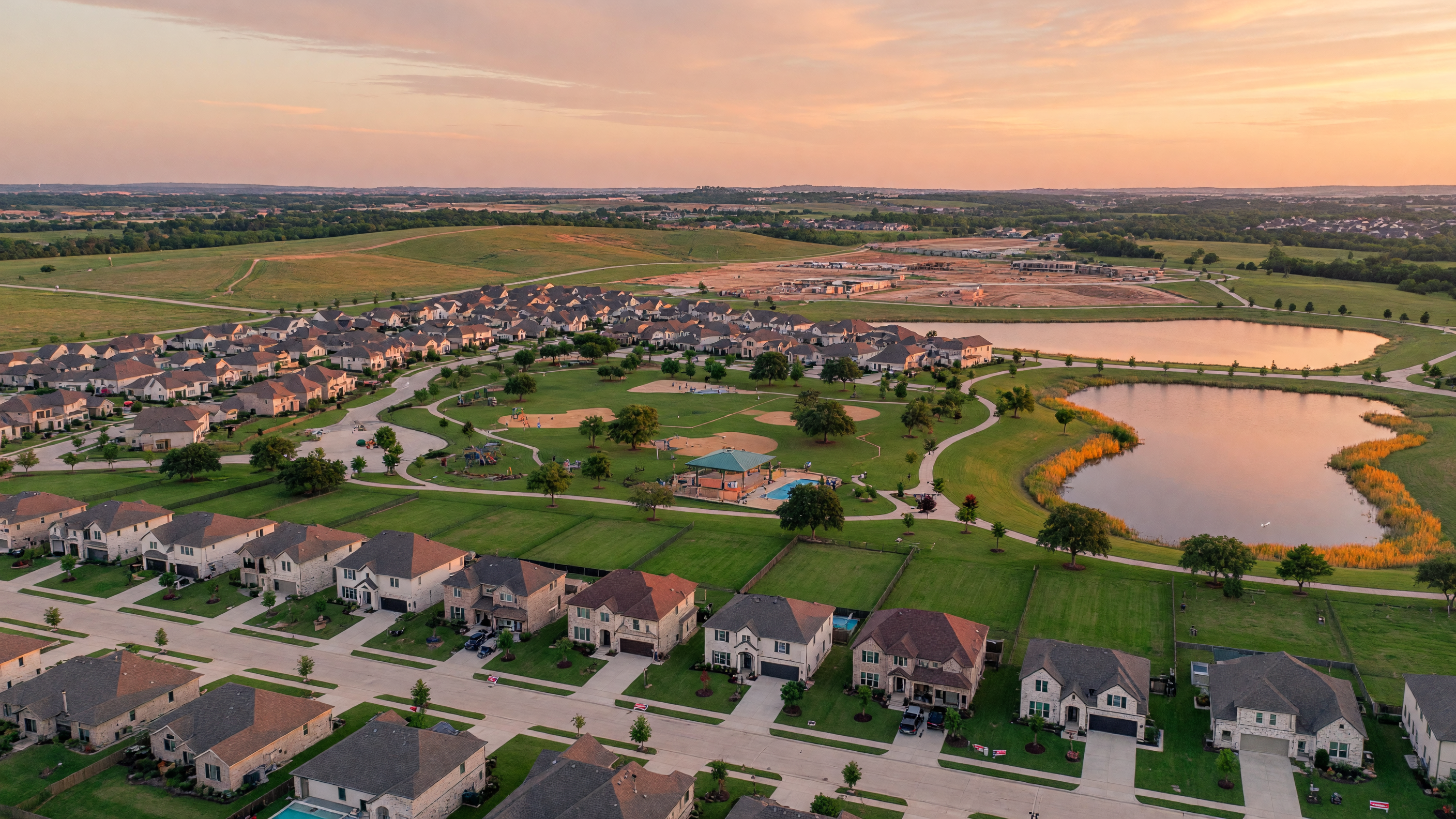
The question this guide answers is practical: how should a buyer evaluate future resale appeal, marketability and competitive position among North Texas new-construction communities? The honest starting point is that no one can reliably predict which community will appreciate the most, so this guide teaches a framework of ten factors buyers can evaluate today, then applies it to current information about Pecan Square, Harvest, Canyon Falls, Landmark by Hillwood and the Argyle area.
Each of those communities is at a different stage of development, with different builders, inventory, homesites, ownership costs and amenities. Comparing them on those concrete dimensions, rather than on promises about the future, is how buyers make confident decisions. If you are weighing new construction against resale, or one community against another, the same framework applies.
Quick Answers
Short, direct answers to the questions buyers ask most about the long-term value of North Texas new-construction communities, based on the verified details in this article. No factor guarantees resale performance, so evaluate the full picture for the specific property.
-
How can I compare the resale potential of North Texas new-construction communities?
Resale potential cannot be predicted with certainty. Compare the factors that affect marketability: development stage, competing builder and resale inventory, homesite characteristics, floor-plan functionality, complete ownership costs, open versus planned amenities, surrounding infrastructure, builder competition, developer execution, and recent comparable sales.
-
What are the trade-offs of buying early in a new master-planned community like Landmark?
Early-stage communities typically offer the widest selection of homesites and floor plans, and current builder pricing may differ from later phases. The trade-offs are ongoing construction, amenities and commercial components that may take years to deliver, plans that can change, and a long buildout timeline.
-
How should I compare property taxes between North Texas communities?
Compare the combined property-tax burden for the specific property: the county rate, the school-district rate, the municipal rate, and any special-district obligations such as MUD, PID, or MMD assessments. A lower municipal rate is only one component of the total tax burden.
-
Can builder incentives affect resale homes in the same community?
Yes. During active buildout, substantial new-home incentives such as rate buydowns, closing-cost assistance, and preferred financing programs can influence how buyers compare a resale home against new inventory, often on a monthly-payment basis. Position your price and condition accordingly.
First, the caveat that matters
Future appreciation and resale performance cannot be predicted or guaranteed. Claims that a community will "hold value," "outperform" or provide "downside protection" are not supportable in advance. Resale results at the time you sell will depend on market conditions, supply and demand, pricing, financing costs, property condition and the specific characteristics of the home. What this guide can do is help you evaluate the factors that describe a community's and a home's competitive position today.
Local Real Estate Broker Perspective
I'm Theresa De La Rosa, Texas Real Estate Broker and REALTOR® with Covenant Heritage Realty, LLC, serving North Texas buyers and sellers. When I help buyers evaluate new-construction communities for future marketability, I start with factors they can verify today: development stage, current builder and resale inventory, incentives, homesite characteristics, floor-plan type, complete ownership costs, amenities that are open versus planned, surrounding infrastructure, builder competition, the developer's execution record and recent comparable sales. None of these factors guarantees future resale performance, but together they describe a home's competitive position.
A Framework for Evaluating Future Marketability
Below are ten factors that buyers can objectively evaluate today. Use them to compare communities and, just as importantly, to compare specific homes and homesites within a community.
1. What stage of development is the community in?
Communities may be in early phase, active buildout, mature or approaching completion. The stage affects the buyer experience: construction traffic, amenity availability, how much of the master plan is delivered and how much new inventory will compete for buyers in the coming years. None of these stages predicts future pricing; each simply changes what a buyer can observe and plan around.
2. How much competing inventory exists?
Count both builder inventory and resale inventory in the community and in the surrounding area. High inventory means more choices for future buyers; low inventory may mean less direct competition. Builder incentives, such as rate buydowns, closing-cost assistance and preferred financing, can make new inventory more attractive on a monthly-payment basis, so inventory should be evaluated together with the incentives attached to it.
3. What are the homesite characteristics?
Evaluate size, orientation, adjacency, road exposure, open-space relationships, easements, drainage and utility placement for each homesite. A homesite that faces a major road, backs to commercial use or sits in an odd shape will appeal to a narrower set of future buyers than a homesite with privacy and stable ground conditions. These characteristics can be inspected and compared today.
4. What is the floor plan and product type?
Detached versus attached, bed/bath configuration, garage configuration and overall layout all define who could live in the home later. A floor plan that is common across dozens of nearby listings competes with more similar homes; a layout that functions well for a broad range of households, or that stands out in the local inventory, tends to draw more buyer interest when it is offered for sale. Count how many active and recently sold homes offer comparable characteristics.
5. What are the complete ownership costs?
Compare the combined property-tax burden for the specific property, including the county rate, the school-district rate, the municipal rate and any applicable special-district obligations such as MUD, PID or MMD assessments. Add HOA assessments, insurance considerations and maintenance responsibilities. A lower municipal rate is only one component of the total; the total effective rate is what affects monthly cost and what future buyers will weigh.
6. Which amenities exist today, and which are only planned?
Separate completed amenities from planned ones. A pool, trail or amenity center that is open and maintained is a current feature of the community; an amenity render on a sales board is not. Ask for the developer's or HOA's written timeline, and treat planned items as subject to change until they are built.
7. What surrounding infrastructure and commercial development is current or approved?
Look at roads, schools, retail, employment centers and services that exist today, plus projects that are officially approved, entitled or under construction. Approved projects can be verified with city, county, school-district and developer records. Their completion timelines can change, and their effect on future resale prices cannot be predicted, so treat them as information about the area rather than as a promise.
8. How does builder competition cut both ways?
Multiple builders can give new-home buyers more choices in floor plans, homesites, pricing and incentives, which can be an advantage when you are buying. The same inventory competes against resale listings during active buildout: a resale home is compared side by side with new spec homes, quick move-in homes and builder financing packages. Understand both sides before and after your purchase.
9. What is the developer's execution record?
A developer's completed master-planned communities can help buyers assess how the developer approaches land planning, amenity delivery, phasing and long-term operation. Past projects and reputational history are context, not a guarantee. Plans, timelines and market conditions change, and developer reputation does not predict future appreciation.
10. What do comparable sales and current market conditions show?
Actual resale performance must ultimately be evaluated using relevant closed sales, active competition and current supply and demand in the specific community. Review recent sales of comparable homes, days on market, sale-to-list ratios and current inventory levels. A real estate professional can pull this data for the exact subdivision or community you are considering.
These ten factors map to the comparison work I do with buyers every day through my new construction buyer representation process. The sections below apply the framework to specific communities using current, verifiable information as of August 2026.
Pecan Square: Established Amenities With Active Buildout
Pecan Square by Hillwood Communities in Northlake was designed around a village-center concept, with gathering spaces, community amenities and programming planned before many of the homes were built. The community spans roughly 1,200 acres and is planned for approximately 3,100 homes at buildout. It was named NAHB Master-Planned Community of the Year in 2025 by the National Association of Home Builders.
What buyers can evaluate today:
- Development stage: mature community with established amenities and active new-construction sales in remaining phases. Not yet at full buildout.
- Active builders: five builders were selling as of August 2026, including Coventry Homes, D.R. Horton, David Weekley Homes, Highland Homes and Pulte Homes. Builder rosters change; verify directly.
- Pricing: varies by builder, phase, and homesite; builders advertise new homes from current published prices. Buyers should verify current figures directly with the builder.
- Amenities: completed amenities include Jackson Hall, The Arena, resort-style pools and splash park, dog park, trails and fiber internet included in HOA dues. Starling Park opened in 2025; Jack's Junction Park and Daffodil Park are planned for fall 2026 and should be verified before relying on them.
- Schools: the community sits within Northwest ISD; Johnie R. Daniel Elementary serves the community, and Floyd Barksdale Middle School opened for the 2026-27 school year with students returning on August 12, 2026. Attendance boundaries can change; verify the assignment for the specific property with Northwest ISD.
Current Market Evidence | Compiled August 17, 2026
A market snapshot from NTREIS listing data shows how new construction and resale inventory currently coexist in Pecan Square:
- 61 active listings, of which 50 were built in 2026 and 11 are resale homes built from 2019 to 2025.
- 9 resale homes closed in the 90 days ending August 17, 2026, with 2 pending; closed resale prices ranged from $415,000 to $649,000.
- Resale median sold price was $590,000 with a median sale-to-list ratio of 98.4% and a median cumulative days on market of 130 days.
This describes current conditions; it is not a prediction. The same data frame the resale seller's checklist: what buyers pay for comparable resale homes, how long they take, and what new inventory with incentives is competing for the same buyers. See the full Pecan Square market update.
For buyers in the roughly $500,000 to $800,000 range, Pecan Square offers a range of options across remaining phases and builders. The resale pool is small relative to new construction today, which is itself a piece of the competitive picture for anyone who later sells.
Harvest: A Mature Community With Select New Inventory
Harvest is a 1,200-acre master-planned "agrihood" by Hillwood Communities spanning Argyle and Northlake at the I-35W and FM 407 interchange. At full buildout it is planned for approximately 4,000 homes across townhomes, single-family homes and estate lots. Harvest is a mature, late-stage community: its amenity package is largely delivered, residents have resale history to study, and remaining new construction is selective rather than broad.
What buyers can evaluate today:
- Active new-construction sellers: as of August 2026, Tri Pointe Homes at The Retreat at Harvest, David Weekley Homes at Retreat at Harvest Gardens, CB JENI Homes (for-sale townhomes) and Drees Custom Homes on estate lots. Builders that previously sold in Harvest, including Highland Homes, Taylor Morrison and Toll Brothers, have largely sold through; verify current availability directly with each builder.
- Pricing: current pricing spans from townhomes in the $300,000s to estate and custom single-family homes above $1.3 million depending on builder, floor plan and homesite. Official Harvest marketing lists new homes starting under $400,000. Pricing changes frequently; verify current figures.
- Townhome status: for-sale townhomes remain available from CB JENI Homes, and Harvest House, Hillwood's rental community with 259 apartments and 90 rental townhomes, is now open and leasing, adding rental inventory within the community.
- Retail: Harvest Town Center includes a 63,000-square-foot Tom Thumb that opened in March 2026, with Chick-fil-A, McDonald's and Chase Bank operational and additional restaurant space under construction. These are existing or approved uses, not projections.
- Amenities: a working community farm, an 11-acre lake, two resort-style pools, The Fit Barn and an extensive trail network are complete and operating.
- Schools: portions of Harvest are served by Argyle ISD and portions by Northwest ISD. Three on-site elementary schools (Lance Thompson, Argyle West and Jane Ruestmann) serve the community. Campus assignments depend on the specific lot; verify directly with the applicable district, as boundaries can change.
Harvest's mix of housing types is broad: townhomes, single-family plans across multiple builders, and estate lots. Because the community is mature, buyers can study years of resale activity rather than relying on projections. Current supply, current pricing and the specifics of each home still determine what happens next.
Canyon Falls: An Established Community Finalizing Buildout
Canyon Falls is a 1,242-acre master-planned community spanning Northlake, Flower Mound and Argyle, built around its natural terrain: limestone canyon walls, creek corridors, scenic ponds and elevated homesites. The community is characterized by completed amenities, including miles of trails, pools, a fitness center, a community lake and the Graham Branch Creek Preserve. For buyers evaluating the Flower Mound sections of Canyon Falls, the Flower Mound relocation guide compares the town's neighborhoods, schools, taxes, and commute routes.
What buyers can evaluate today:
- Development stage: Canyon Falls is approaching the end of residential development. The Flower Mound Town Council approved the final residential subdivision, Canyon Falls Village 3, a 27-acre, 65-home phase, on January 20, 2026.
- Active builders: as of August 2026, Chesmar Homes (from approximately the $690,000s, depending on homesite) and Windmiller Custom Homes (from approximately $990,000+) are selling new homes. Prior builders including Drees Custom Homes and Pulte Homes are no longer actively selling new inventory.
- Competitive environment: declining new-builder inventory changes the competitive environment: fewer new homes will compete with resale listings as phases sell out. Resale outcomes still depend on supply, demand, pricing, condition and property characteristics at the time of sale.
- Schools: Canyon Falls is served by both Argyle ISD and Northwest ISD depending on the specific lot location. Verify the assignment for the property directly with the applicable district; boundaries can change.
Buyers here evaluate a maturing community with an established resale record, significant natural amenities and a limited window of remaining new construction. How the final phase sells and what current resale comparables show will be the meaningful market evidence to follow.
Landmark by Hillwood: An Early-Stage Community With a Long Horizon
Landmark by Hillwood is a 3,200-acre master-planned community in southwest Denton at I-35W and Robson Ranch Road. Hillwood's announced long-term master plan includes approximately 6,000 single-family homes, more than 3,000 multifamily units and more than 5 million square feet of commercial and mixed-use space, with roughly 1,100 acres of parks, trails and conserved open space. The buildout is expected to span decades.
What Phase 1 looks like as of August 2026:
- Phase 1: approximately 747 single-family lots with nine builders selling, including American Legend Homes, Coventry Homes, David Weekley Homes, Drees Custom Homes, Highland Homes, M/I Homes, Perry Homes, Toll Brothers and Tri Pointe Homes.
- Pricing: homes are marketed from approximately the high $300,000s to $1 million+, depending on builder, floor plan and homesite. First move-ins began in summer 2026, and model homes opened earlier in the year.
- Planned versus delivered: the first amenity center is targeted to open in late 2026. Denton's first H-E-B grocery store has been under construction since fall 2025 and is anticipated to open in early 2027, though schedules are subject to change. The full commercial district and most amenities remain planned, not built.
- Schools: Landmark is in Denton ISD. The master plan sets aside land for three on-site schools (two elementary and one middle), subject to future bond elections. Verify current attendance boundaries directly with Denton ISD.
Landmark gives buyers an opportunity to evaluate an early-stage master-planned community, which carries a different set of considerations than buying in an established community. Planned amenities and commercial components may take years to deliver, plans can change, and ongoing construction may continue for an extended period. Early entry is not lower risk, guaranteed upside or an investment strategy; it is simply a different point in the development timeline.
The Argyle Area: Large-Lot and Custom Options Across Multiple Developments
Argyle is a municipality containing multiple neighborhoods and developments, not a single community that competes with Pecan Square or Harvest as one product. Buyers looking at the Argyle area are typically evaluating a set of distinct developments, several of which focus on large homesites, custom building and luxury product.
- Furst Ranch: a 2,300-acre master-planned community at US 377 and FM 1171, with roughly 1,400 homes planned across its first three neighborhoods, including a large-lot neighborhood on half-to-one-acre homesites and a luxury estate section on one-to-two-acre homesites. Active and announced builders include Tradition Homes, Drees Custom Homes, Shaddock Homes and David Weekley Homes, and Toll Brothers is actively selling as of October 2026 (builder-reported), with the Grove Collection around $851,995 and the Meadow Collection around $1.1 million. See the Furst Ranch community guide.
- Toll Brothers Enclave at Hickory Hill: a Toll Brothers community on one-acre homesites in Argyle that grand-opened in February 2026, with homes from approximately $1.4 million and above, within Argyle ISD.
- Creek Meadows West: a Northlake community on one-acre homesites with Drees Custom Homes and Toll Brothers, offering another large-lot comparison in the same corridor.
These developments differ in builder lineup, homesite size, price point, district and stage. They are best compared property by property using the framework above rather than treated as one "Argyle" option.
Schools: Objective Information to Verify
School information belongs in this guide as objective property information, not as a value prediction. Every community above sits within one or more school districts: Northwest ISD (Pecan Square, portions of Harvest and portions of Canyon Falls), Argyle ISD (portions of Harvest, portions of Canyon Falls, Furst Ranch and Enclave at Hickory Hill) and Denton ISD (Landmark). School attendance boundaries, feeder patterns and ratings can change. Buyers should verify current assignments for the specific property directly with the applicable school district before making a purchase decision. A campus assignment is one factor among many in the framework above.
How I Help Buyers Evaluate Future Marketability in New Construction
Buyers often tell me the hardest part of new construction is comparing things that look similar on the surface. I help structure the comparison around current, verifiable information rather than assumptions. The questions below are the framework I work through with clients:
- What will this home compete against if I sell?
- How much builder inventory remains in the community and the area?
- Are builders offering incentives that could compete against a resale listing?
- How does this homesite compare with others in the community?
- Is the floor plan common or differentiated in the current inventory?
- What are the complete ownership costs, including all tax layers and assessments?
- Which amenities and infrastructure exist today versus being planned?
- What do current comparable sales actually show in this community?
I can help buyers compare builder offerings, transaction terms within brokerage scope, current inventory, homesites, incentives, timelines and market competition. I do not determine construction quality, provide legal contract review or guarantee builder warranty performance. When a decision calls for it, I recommend appropriate licensed inspectors, attorneys, lenders, tax professionals or other specialists. My role is to bring current market evidence and clear analysis to your decision. You can read more about how I work in my new construction buyer representation guide.
Selling a Home in a New Construction Community
For homeowners considering selling while builders are still active in the community, the competitive landscape is concrete: resale sellers compete with other resale listings, builder inventory, quick move-in homes, and builder financing and incentive programs. When I help sellers evaluate their position, we compare current comparable closed sales within the community, current builder pricing and inventory levels, the incentives builders are offering, and the specific characteristics of the home that may differentiate it from new construction. The goal is a pricing and marketing strategy that reflects real market conditions rather than assumptions about how the market "should" behave.
For qualifying listings, enhanced marketing tools such as Zillow Showcase (premium placement with enhanced media) may be part of a comprehensive marketing plan. There are no guarantees with any marketing approach, but a data-driven pricing and positioning strategy gives sellers the best chance of attracting the right offer in a competitive market.
The Bottom Line
No community ranking can tell you what will happen to prices in the future. What buyers can do is compare development stage, competing inventory, homesite characteristics, floor-plan functionality, complete ownership costs, delivered amenities, surrounding infrastructure, builder competition, developer execution and current comparable sales. Pecan Square, Harvest, Canyon Falls, Landmark and the Argyle area each sit at a different point on that set of dimensions, and the home you choose within a community often matters as much as the community itself.
The community that fits your timeline, budget and housing needs is the one worth a closer look, and the framework in this guide is how to look at it fairly. Start with current data, verify what can be verified, and treat everything future as subject to change.
Find a Community Built for Long-Term Value
Compare communities on schools, taxes, amenities, and projected growth before you choose.
Explore Long-Term Value CommunitiesPrefer to talk it through? Call (940) 240-3800.
Thank you,
Theresa De La Rosa
Broker, REALTOR®
Covenant Heritage Realty, LLC | In DFW Living Group
Disclaimer: This article discusses factors buyers may consider when evaluating future marketability and competitive position. It is not a prediction or guarantee of future property value, appreciation or resale performance. Builder participation, pricing, inventory, incentives, school assignments and attendance boundaries, tax rates, HOA dues, special assessments, amenities and development plans are subject to change. Buyers should independently verify current information with the applicable builder, developer, city, school district and county, and evaluate the specific property and their financial circumstances before purchasing.

Theresa is the founder and Broker of Covenant Heritage Realty, LLC and a Texas Real Estate Broker and REALTOR®, serving sellers, buyers and military and veteran clients throughout North Texas. With 18+ years of experience, she provides strategic, data-driven real estate guidance focused on client advocacy and informed decision-making. She holds the Accredited Buyer's Representative (ABR) designation, is a Certified Luxury Marketing Specialist, an A.I. Certified Broker and New Construction Specialist, and an AI Listing Advantage holder, and has been recognized as a RateMyAgent Price Expert and a Million Dollar Club producer.
Frequently Asked Questions
How can I compare the resale potential of North Texas new-construction communities?
Resale potential cannot be predicted with certainty. What you can do is compare the factors that affect marketability: development stage, competing builder and resale inventory, homesite characteristics, floor-plan type and functionality, complete ownership costs, amenities that are open versus planned, surrounding infrastructure, builder competition, developer execution and recent comparable sales. Working through those ten factors with current data is more reliable than any community ranking.
What are the trade-offs of buying early in a new master-planned community like Landmark?
Early-stage communities typically offer the widest selection of homesites and floor plans, and current builder pricing may differ from later phases. The trade-offs include ongoing construction activity, amenities and commercial components that may take years to deliver, plans that can change, and a long buildout timeline. Whether early entry suits you depends on your timeline and preferences, not on a prediction about appreciation.
How should I compare property taxes between North Texas communities?
Compare the combined property-tax burden for the specific property, including the county rate, the school-district rate, the municipal rate and any applicable special-district obligations such as MUD, PID or MMD assessments. Each component can vary by address, and the total effective rate is what affects monthly cost. A lower municipal rate is only one component of the total tax burden, so compare the full picture property by property.
What factors should I evaluate for future resale marketability?
Evaluate development stage, competing inventory (both builder and resale), homesite characteristics, floor-plan functionality and product type, complete ownership costs, delivered versus planned amenities, surrounding infrastructure and approved commercial development, builder competition and incentives, the developer's execution record, and current comparable sales and market conditions. None of these factors guarantees future resale performance; together they describe competitive position.
Can builder incentives affect resale homes in the same community?
Yes. During active buildout, substantial new-home incentives such as rate buydowns, closing-cost assistance and preferred financing programs can influence how buyers compare a resale home against new inventory, often on a monthly-payment basis. Resale sellers should evaluate current builder offerings, incentives and inventory when positioning price and condition.
Should I buy in an established community or a brand-new one?
Both have trade-offs. Established communities let buyers evaluate completed amenities, an existing resale record and current resale competition. Brand-new communities may offer different inventory and homesite choices, but they come with uncertainty about development timelines, planned amenities and future competition from continuing buildout. The right answer depends on your timeline, budget and preferences; neither choice guarantees future resale performance.